Armstrong, docks and a house of water
From the town mains to a house that turned water into light
The IMechE says Joseph Bramah and William George Armstrong “are often considered the fathers of hydraulic engineering.” Armstrong, it adds, was president of the Institution, and his home, Cragside in Northumberland, “was the first domestic building to be powered by hydro-electricity.” That “first” is the IMechE’s wording, and it is left on that page.
The 1911 Britannica gives Armstrong a solicitor’s beginning. He was born on 26 November 1810 at Newcastle-on-Tyne, educated at a school in Bishop Auckland, and from 1833 to 1847 practised in Newcastle with the firm of Donkin, Stable & Armstrong. “His sympathies, however, were always with mechanical and scientific pursuits,” and several of his inventions date from before he finally abandoned the law. [source]
In 1841–1843 he published papers on the electricity of effluent steam, a subject he was led to by a colliery engineman who “noticed that he received a sharp shock on exposing one hand to a jet of steam issuing from a boiler with which his other hand was in contact.” The inquiry was followed by the invention of the “hydro-electric” machine, “a powerful generator of electricity, which was thought worthy of careful investigation by Faraday.” [source]
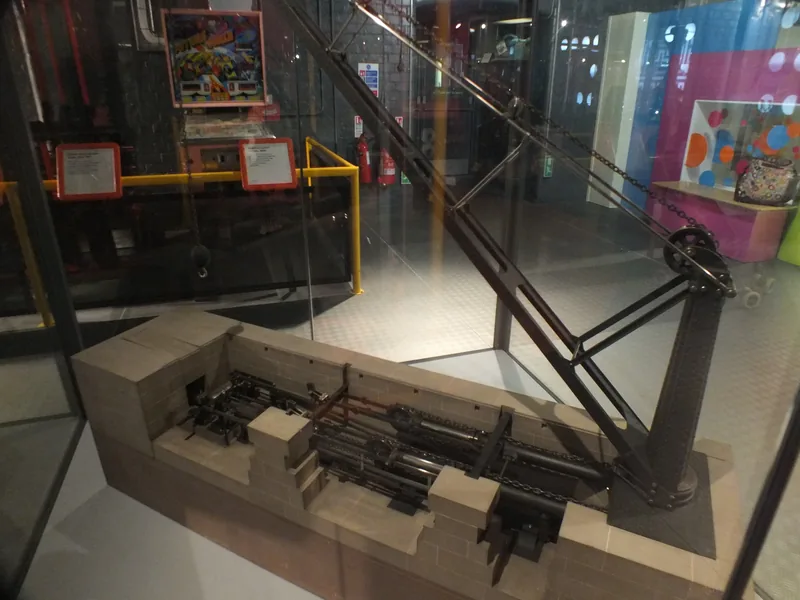
Even earlier, the same article says, the utilisation of water-power had engaged his attention, and in 1839 he invented an improved rotary water motor. Soon afterwards he designed a hydraulic crane, “which contained the germ of all the hydraulic machinery for which he and Elswick were subsequently to become famous.” The machine “depended simply on the pressure of water acting directly in a cylinder on a piston, which was connected with suitable multiplying gear.” The first example “was erected on the quay at Newcastle in 1846,” and “the necessary pressure was obtained from the ordinary water mains of the town.” [source]
The merits of the device, the 1911 article says, “soon became widely appreciated, and a demand arose for the erection of cranes in positions where the pressure afforded by the mains was insufficient.” Pressure could always be obtained by special reservoirs, “but to build these was not always desirable, or even practicable.” [source]
Hence the scene that still has a slightly comic practicality. In 1850 a hydraulic installation was required for a new ferry station at New Holland, on the Humber estuary. There were “no water mains of any kind,” and a special reservoir was prohibitive “owing to the character of the soil.” Armstrong invented a fresh piece of apparatus, the accumulator: “a large cylinder containing a piston that can be loaded to give any desired pressure, the water being pumped in below it by a steam-engine or other prime mover.” The 1911 Britannica says this simple device “may be looked upon as the crown of the hydraulic system,” since by its various modifications “the installation of hydraulic power became possible in almost any situation.” In particular, “it was rendered practicable on board ship,” including “the manipulation of heavy naval guns.” The Elswick works “were originally founded for the manufacture of this hydraulic machinery.” [source]
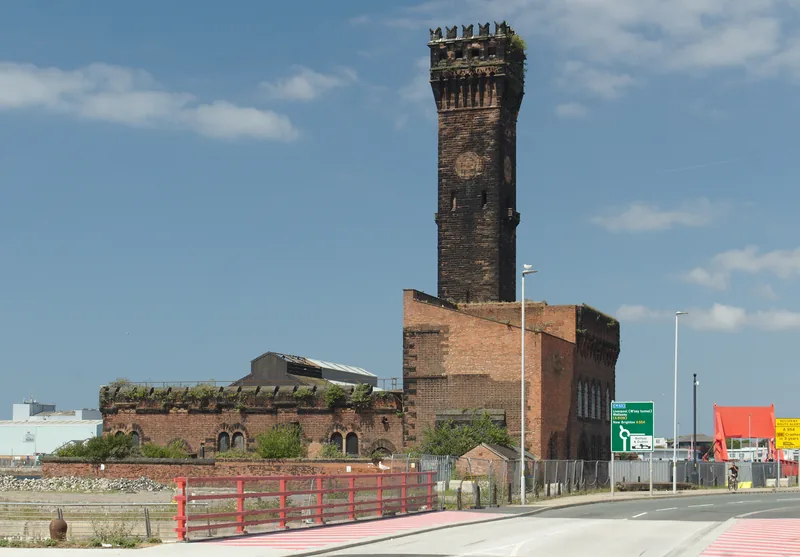
At Cragside, the National Trust describes a later, domestic twist on the same dockside idea. At the Powerhouse, visitors “discover how William Armstrong turned water into light.” At the Pump House, they “find out how William Armstrong adapted his dock-side hydraulic crane technology to push water up the hillside to the Basin Tank.” The twin Nelly’s Moss Lakes “were once the vital water stores for William Armstrong’s hydroelectricity system.” Those are the Trust’s sentences. The IMechE’s claim that Cragside was the first domestic building powered by hydro-electricity is not added to them. [source] [source]
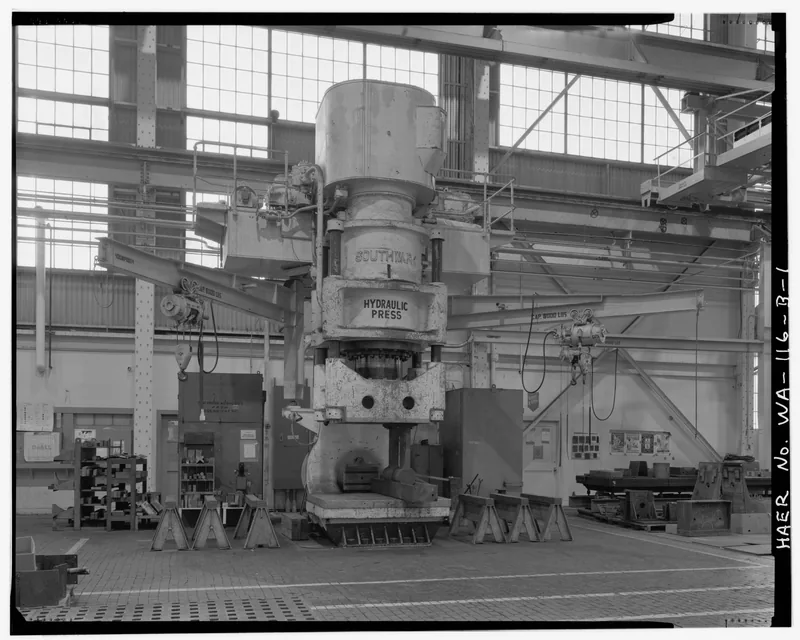
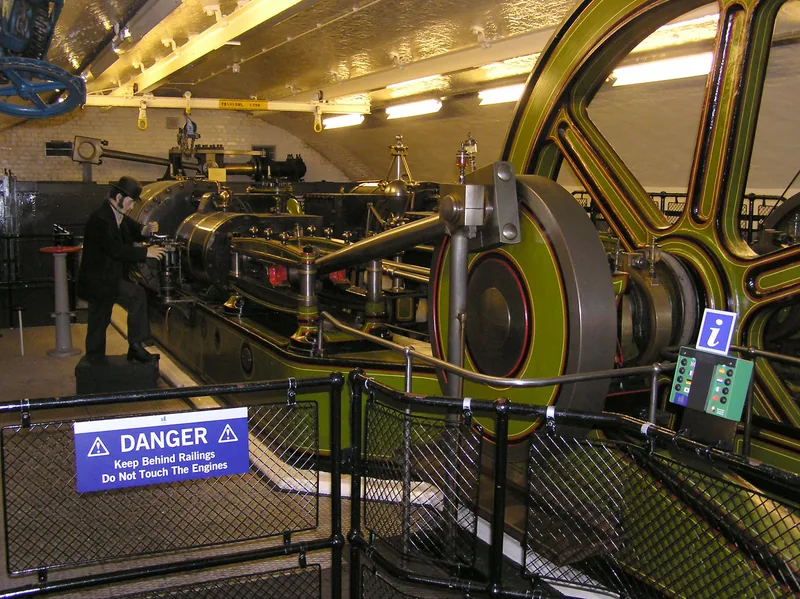
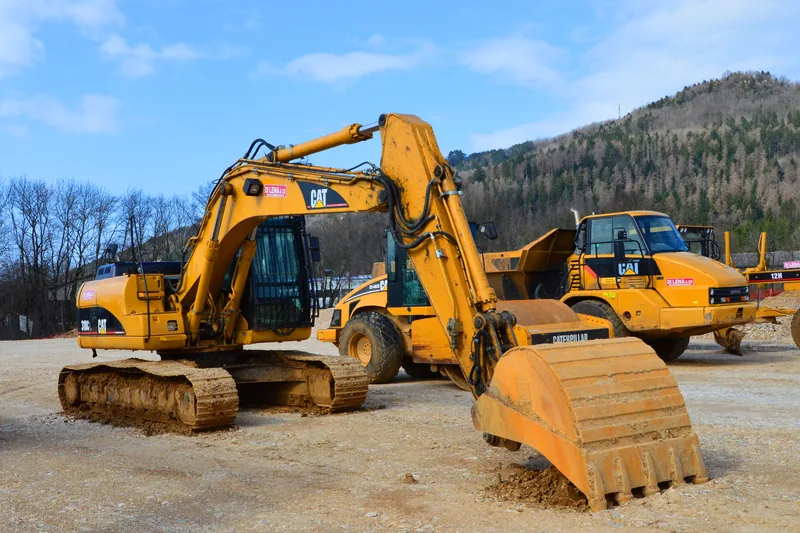
The hydraulic press never left the workshop floor. A 1911 book plate still shows a huge press with a man at its foot for scale. A lantern slide of about 1910 shows a Tangye 200-ton skin and hide press from the rear. John Stamets, photographing for the Historic American Engineering Record, recorded a 1000-ton forging press at Puget Sound Naval Shipyard. And a yellow excavator on a French hillside is only one of the later machines that still move by oil in a cylinder — identified here by the name on the photograph, and not by any official list of modern uses.
Enjoyed this hydraulics desk?
No pop-ups. No intrusive advertising. Just interesting stuff. A little support helps the next mechanics.im site get built.