Questions
Questions people actually ask
- What is a hydraulic press, in official wording?
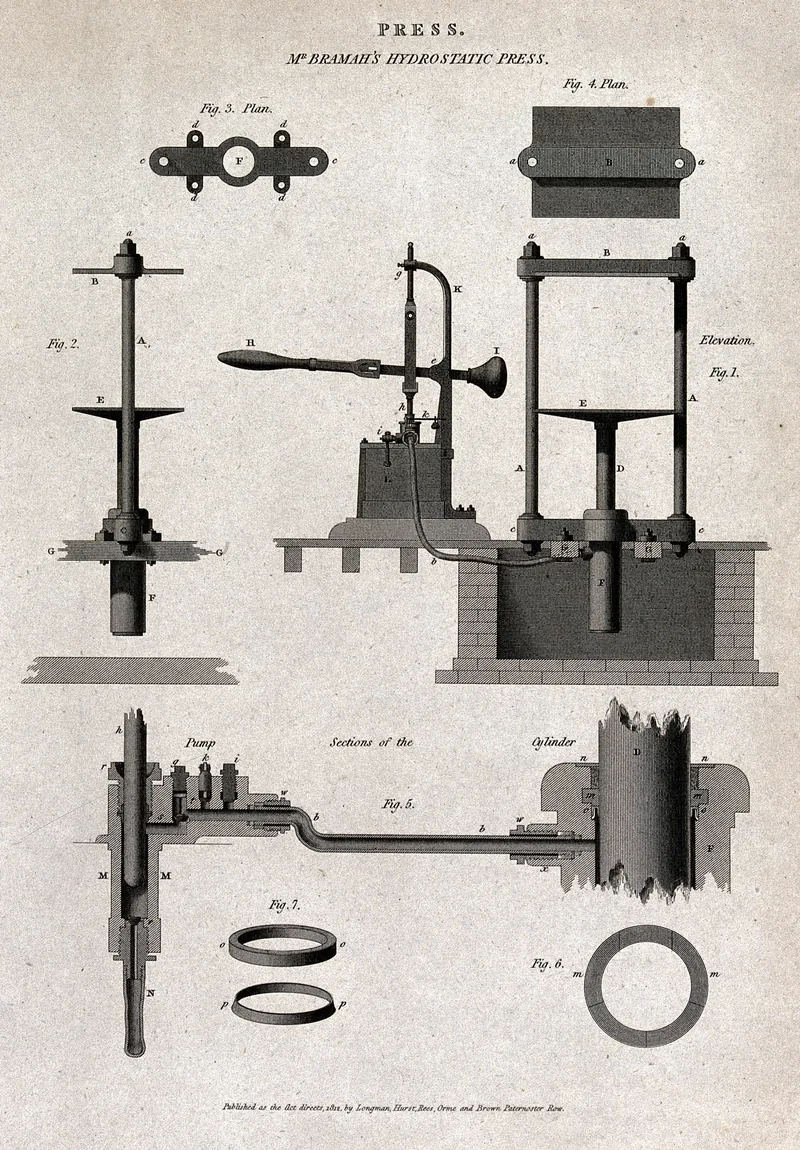
- The IMechE describes Bramah’s press as two cylinders and pistons of different areas, depending on Pascal’s principle “that pressure throughout a closed system is constant.” A force on the smaller piston is translated into a larger force on the larger one, in proportion to the areas, “in a similar way to that in which a lever is used.” [source]
- Did Pascal invent that press?
- No official page used here says so. Pascal’s treatise on the equilibrium of fluids was written, the 1911 Britannica says, before 1651 and published in 1663. Bramah’s press is dated 1795 on both the 1911 article and the IMechE page. [source] [source] [source]
- Why do two official sentences about pressure sound slightly different?
- Because they are different sentences. The 1911 “Hydraulics” article speaks of pressure in all directions at a point in a fluid. The IMechE, describing the press, speaks of pressure throughout a closed system being constant. This site quotes both and does not rewrite them into one. [source] [source]
- What was Bramah’s Challenge Lock?
- A lock finished in 1790, the IMechE says, displayed in his shop window with an offer of 200 guineas to anyone who could pick or open it. Alfred Charles Hobbs picked it in 1851, during the Great Exhibition, in more than 50 hours across 16 days. The lock in the Science Museum has been rebuilt since. [source]
- Who was Henry Maudslay, in this story?
- One of Bramah’s workmen, the 1911 Britannica says, to whom Bramah was indebted for the collar that kept the press plunger watertight, and who also helped design machines for making the locks. The IMechE also names him among engineers trained in Bramah’s workshop, with Joseph Clement and Joseph Whitworth. [source] [source]
- How did Armstrong’s first crane get its pressure?
- From “the ordinary water mains of the town,” the 1911 Britannica says, when the first example was erected on the Newcastle quay in 1846. [source]
- What is an accumulator, in the 1911 wording?
- “A large cylinder containing a piston that can be loaded to give any desired pressure, the water being pumped in below it by a steam-engine or other prime mover.” Armstrong invented it, that article says, for a ferry station at New Holland in 1850, and the same page calls it “the crown of the hydraulic system.” [source]
- Is Cragside part of the hydraulic story?
- Yes, on two official pages that are not blended here. The IMechE calls it the first domestic building powered by hydro-electricity, and notes that Armstrong was president of the Institution. The National Trust describes how he turned water into light, and how he adapted dock-side hydraulic crane technology to push water up to the Basin Tank. [source] [source]
- Why does this site sometimes refuse to decide?
- Because the sources disagree, or because they are careful. Bramah’s year of birth, the place of his death, and the wording of the pressure principle are left unblended. “Apparently,” in the Osborne House sentence, is left in. [source] [source]
- Are the photographs of the original machines?
- Not always, and the captions say so. The Lyon press is a teaching machine. The Armstrong crane photograph is a museum model. The Pascal image is a later portrait print. The Wellcome plate is an engraving, not a photograph of a surviving press.
- Does this site sell paid kits?
- No. There are three free typographic fact sheets, in A4 and Letter, with no photographs inside, plus links to the ReallyByte shop, Amazon searches and a birthday card.
- How are visits counted?
- With GoatCounter. A visible “Visitors to this page” counter appears on every page. There are no pop-ups and no intrusive advertising.
Enjoyed this hydraulics desk?
No pop-ups. No intrusive advertising. Just interesting stuff. A little support helps the next mechanics.im site get built.