Myths versus facts
What the sources do not say
A hydraulic desk collects surprising official stories. It also has to leave legends, later guesses, and tidy compromises out. Here are twelve checks.
- Myth: Pascal built the first hydraulic press.
- Fact: The 1911 Britannica ranks Pascal among the founders of hydrodynamics and describes his treatise on the equilibrium of fluids, written before 1651 and published in 1663. The press patent, on both official accounts used here, belongs to Bramah in 1795. [source] [source] [source]
- Myth: The IMechE and the 1911 Britannica use the same sentence for Pascal’s principle.
- Fact: The IMechE writes of “pressure throughout a closed system is constant.” The 1911 article “Hydraulics” writes that “at any point in a fluid the pressure in all directions must be the same.” Those wordings are close, and they are not the same. [source] [source]
- Myth: This site’s 2×, 5×, 10× and 20× figures are measurements of Bramah’s press.
- Fact: They are illustrations of the IMechE’s area rule — force proportional to area. The IMechE does not give those multipliers as historic ratings. [source]
- Myth: We know, without doubt, that a Bramah closet still works at Osborne House.
- Fact: The IMechE’s word is “apparently.” This site keeps the caution. [source]
- Myth: Bramah died in one agreed place on 9 December 1814.
- Fact: The IMechE says he died in Holt Forest, Hampshire, on that date. The 1911 Britannica says he died in London on that date. This site does not choose. [source] [source]
- Myth: He was born in 1748, and that is the end of the matter.
- Fact: The 1911 Britannica gives 13 April 1748 at Stainborough. The IMechE gives 1748, “some accounts say 1749.” Both remain on the desk. [source] [source]
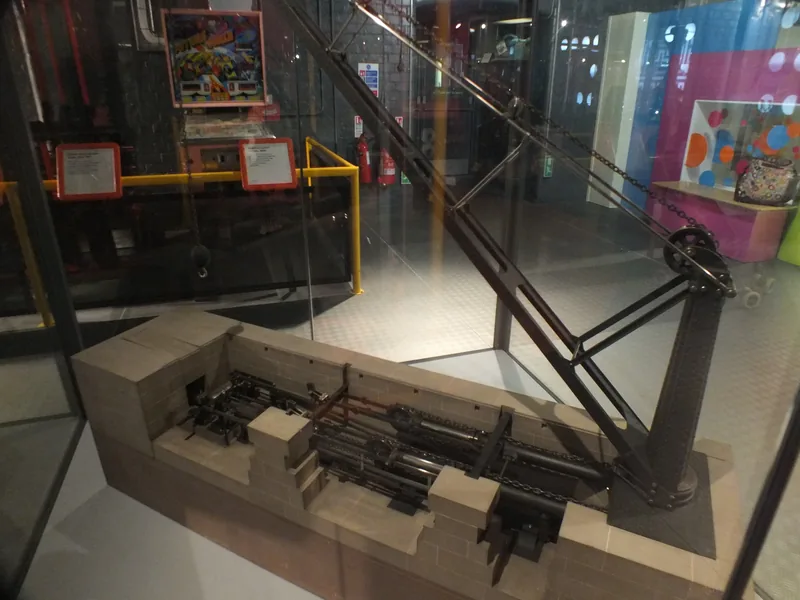
- Myth: The museum crane in the photograph is the 1846 Newcastle quay crane.
- Fact: The photograph is identified as an 1850 model at the Discovery Museum, taken in 2013. The 1846 quay crane is an official story from the 1911 Britannica, not that object.
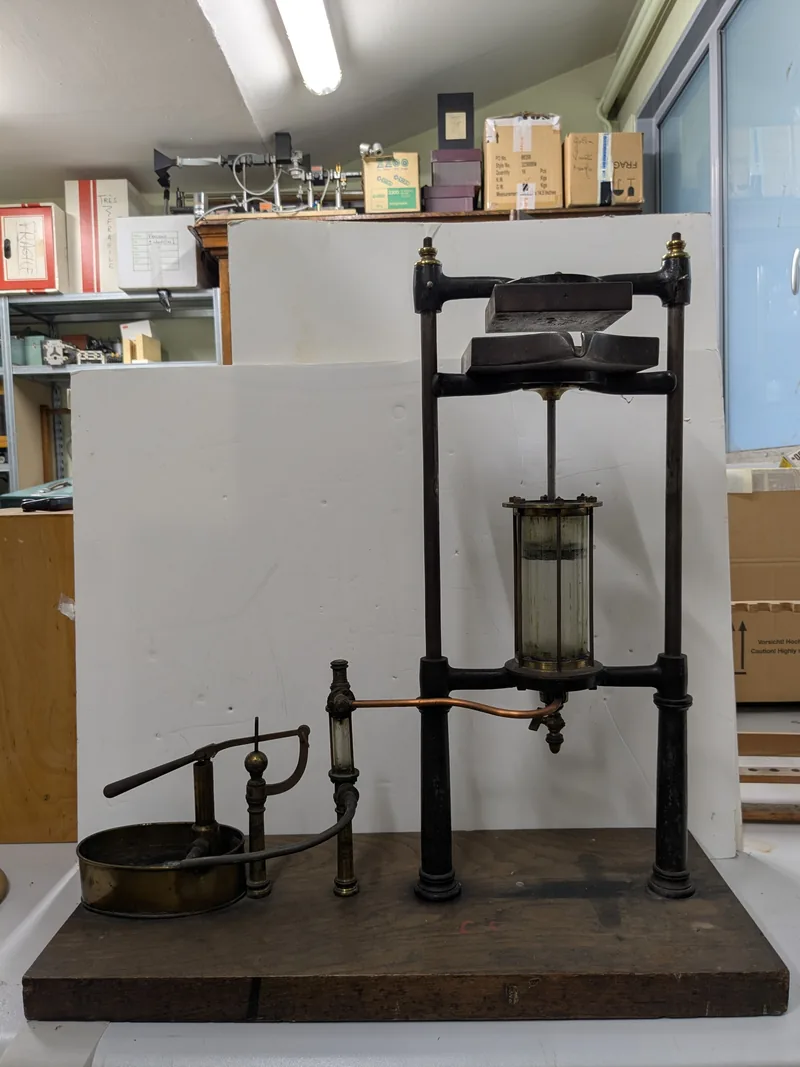
- Myth: The Lyon press is Bramah’s original machine.
- Fact: It is a teaching press in a university physics collection. The caption says so.
- Myth: The National Trust and the IMechE use the same “first” sentence about Cragside.
- Fact: The IMechE calls Cragside “the first domestic building to be powered by hydro-electricity.” The National Trust page quoted here speaks of turning water into light, a pump house adapted from dock-side crane technology, and the Nelly’s Moss Lakes. This site does not add the IMechE’s “first” to the Trust’s sentences. [source] [source]
- Myth: Dark, still oil in a cylinder is a modern idea with no nineteenth-century ancestors.
- Fact: Armstrong’s 1846 crane, the 1911 Britannica says, depended on “the pressure of water acting directly in a cylinder on a piston.” The later machines in the photographs are not evidence against that earlier official story. [source]
- Myth: Pascal’s 1911 rank is as a founder of “hydrostatics,” so we may as well update the word.
- Fact: The 1911 word is hydrodynamics. This site leaves it. [source]
- Myth: If two official pages almost agree, the slightly different figures can be averaged.
- Fact: They cannot. Birth years, places of death, and wordings of the pressure principle are kept unblended, with the disagreement moved into the open on this page and in the field notes.
Enjoyed this hydraulics desk?
No pop-ups. No intrusive advertising. Just interesting stuff. A little support helps the next mechanics.im site get built.