Facts
90 official facts, kept to their pages
Each fact below is taken from an official sentence, or from a photograph’s own identification. Where two sources disagree — Bramah’s year of birth, or the place of his death — both wordings are given, and neither is tidied away.
Born in Yorkshire, 1748 — or, some accounts say, 1749
The IMechE says Joseph Bramah was born in Yorkshire in 1748, and adds that “some accounts say 1749.” [source]
13 April 1748, at Stainborough
The 1911 Encyclopaedia Britannica says he was the son of a farmer, born at Stainborough, Yorkshire, on 13 April 1748. [source]
An accident to his ankle
The same 1911 article says he was “incapacitated for agricultural labour by an accident to his ankle.” [source]
A walk to London
The IMechE says he started as a farm labourer, was apprenticed to a local carpenter, and walked to London, where he found work as a cabinetmaker. [source]
Cabinet-maker, then his own business
The 1911 Britannica says that on the expiry of his indentures he worked as a cabinet-maker in London, “where he subsequently started business on his own account.” [source]
First patent, 1778: a water closet
Both official accounts date his first patent to 1778. The 1911 Britannica calls it “some improvements in the mechanism of water-closets.” [source] [source]
Apparently, at Osborne House
The IMechE writes: “Apparently, one of these can be found working in Queen Victoria’s residence, Osborne House on the Isle of Wight.” [source]
A beer pump from the cellar to the parlour
The IMechE says Bramah became interested in serving fresh beer in taverns and devised a method of pumping beer from the cellar to the parlour. [source]
Move rather than compress
“The principle of his invention was that if pressure is applied to a contained fluid it will move rather than compress.” [source]
Casks, a cistern, and a loaded piston
His beer pumping system “comprised sets of casks connected to a forcing pump. The sets of casks could be cleaned using a water cistern, and pressure was applied to the stored alcohol by a loaded piston.” [source]
Pipes of tin and lead, extruded under pressure
In the same patent, the IMechE says, Bramah “specified a new method for extruding tin and lead under pressure to make continuous pipes which he intended to use in his beer pumping system.” [source]
The beer-engine, in the 1911 list
The 1911 Britannica includes “the beer-engine for drawing beer” among his other inventions. [source]
The lock known by his name, 1784
In 1784, the 1911 Britannica says, “he patented the lock known by his name.” The IMechE says his first patented lock was developed in 1784 “and made by Bramah Locks, a firm that is still in business.” [source] [source]
The Challenge Lock, 1790
The IMechE says the Challenge Lock was finished in 1790 “and it took pride of place in his shop window.” [source]
A prize of 200 guineas
The inscription, as the IMechE quotes it, was: “The artist who can make an instrument that will pick or open this lock shall receive 200 guineas the moment it is produced.” [source]
Picked in 1851, in more than 50 hours
“It was not until 1851, during the Great Exhibition, that the American Alfred Charles Hobbs managed it; mind you, it took him more than 50 hours across 16 days!” Hobbs “was himself a locksmith.” [source]
Rebuilt, and still in the Science Museum
“The Challenge Lock can be viewed in the Science Museum in London, although it has been rebuilt since Hobbs picked it.” [source]
The hydraulic press, 1795
The 1911 Britannica says that in 1795 he invented the hydraulic press. The IMechE says he was granted a patent for his hydraulic press in 1795, and that it is considered his most important invention. [source] [source]
Pascal’s principle, in IMechE wording
The press, the IMechE says, “depends on Pascal’s principle, that pressure throughout a closed system is constant.” [source]
Two cylinders, force proportional to area
“The press had two cylinders and pistons of different cross-sectional areas. If a force was exerted on the smaller piston, this would be translated into a larger force on the larger piston. The difference in the two forces would be proportional to the difference in area of the two pistons.” [source]
A liquid lever
“Therefore, the cylinders act in a similar way to that in which a lever is used to increase the force exerted.” [source]
Maudslay’s collar
For “the collar which secured water-tightness between the plunger and the cylinder in which it worked,” the 1911 Britannica says Bramah “was indebted to Henry Maudslay, one of his workmen.” [source]
Machines for making locks
Maudslay, the same article says, “also helped him in designing machines for the manufacture of his locks.” [source]
A workshop of later famous engineers
The IMechE says Bramah “had established his own workshop by the late 1770s which trained several famous engineers including Henry Maudslay, Joseph Clement and Joseph Whitworth.” [source]
A numerical printing machine, 1806
In 1806, the 1911 Britannica says, “he devised for the Bank of England a numerical printing machine, specially adapted for bank-notes.” [source]
Aerated waters, planing machines, paper and steam
Other inventions, the same article says, “included … machinery for making aerated waters, planing machines, and improvements in steam-engines and boilers and in paper-making machinery.” [source]
Screw propulsion, suggested in 1785
“In 1785 he suggested the possibility of screw propulsion for ships.” [source]
Hydraulic transmission of power, 1802
“And in 1802 the hydraulic transmission of power.” [source]
Waterworks at Norwich, 1790 and 1793
“He constructed waterworks at Norwich in 1790 and 1793.” [source]
A hydrostatic press for trees
“One of Bramah’s last inventions was a hydrostatic press capable of uprooting trees.” [source]
Pneumonia in Holt Forest
“While working in Holt Forest, Hampshire, he caught pneumonia. He died there on 9 December 1814.” That is the IMechE’s wording. [source]
Died in London, same date
The 1911 Britannica says: “He died in London on the 9th of December 1814.” The date agrees with the IMechE; the place does not. [source]
Fathers of hydraulic engineering
“Bramah and William George Armstrong are often considered the fathers of hydraulic engineering.” [source]
Armstrong as president of the IMechE
“Armstrong was president of the IMechE.” [source]
First domestic hydro-electricity, in IMechE wording
Armstrong’s home, “Cragside in Northumberland, was the first domestic building to be powered by hydro-electricity.” That “first” is the IMechE’s sentence. [source]
A treatise written before 1651, published 1663
The 1911 Britannica says Pascal’s treatise on the equilibrium of fluids was “written before 1651, published 1663.” [source]
Ranked with Galileo and Stevinus
His experiments and that treatise “entitle him to rank with Galileo and Stevinus as one of the founders of the science of hydrodynamics.” Hydrodynamics is the 1911 word. [source]
The mercury column falls as it is carried up
Pascal’s famous experiment showed “that the height of the mercury column in a barometer decreases when it is carried upwards through the atmosphere.” [source]
A tower in Paris
“This experiment was made by himself in a tower at Paris.” [source]
And on the Puy de Dôme, by Florin Périer
It “was carried out on a grand scale under his instructions by his brother-in-law Florin Périer on the Puy de Dôme in Auvergne.” [source]
Galileo and Torricelli, brought home
Its success “greatly helped to break down the old prejudices, and to bring home to the minds of ordinary men the truth of the new ideas propounded by Galileo and Torricelli.” [source]
Pressure in all directions must be the same
The 1911 article “Hydraulics” says: “at any point in a fluid the pressure in all directions must be the same; or, in other words, the pressure on any small element of surface is independent of the orientation of the surface.” [source]
A pressure, not a tension
“The parts of a fluid act on each other with a pressure which is exactly or very nearly normal to the interface which separates them. The stress must be a pressure, not a tension, or the parts would separate.” [source]
Liquids and gases, in 1911 wording
“Fluids are divided into liquids, or incompressible fluids, and gases, or compressible fluids.” [source]
Liquids shrink only a little
“Very great changes of pressure change the volume of liquids only by a small amount.” [source]
Armstrong born 26 November 1810
The 1911 Britannica says William George Armstrong was born on 26 November 1810 at Newcastle-on-Tyne. [source]
Schooled at Bishop Auckland
He “was educated at a school in Bishop Auckland.” [source]
A solicitor until 1847
“The profession which he adopted was that of a solicitor, and from 1833 to 1847 he was engaged in active practice in Newcastle as a member of the firm of Donkin, Stable & Armstrong.” [source]
Inventions before he left the law
“Several of his inventions date from a time anterior to his final abandonment of the law.” [source]
Papers on the electricity of effluent steam
“In 1841–1843 he published several papers on the electricity of effluent steam.” [source]
A sharp shock from a jet of steam
He was led to the subject “by the experience of a colliery engineman, who noticed that he received a sharp shock on exposing one hand to a jet of steam issuing from a boiler with which his other hand was in contact.” [source]
A hydro-electric machine, and Faraday
The inquiry “was followed by the invention of the ‘hydro-electric’ machine, a powerful generator of electricity, which was thought worthy of careful investigation by Faraday.” [source]
A rotary water motor, 1839
“In 1839 he invented an improved rotary water motor.” [source]
The germ of Elswick’s hydraulic machinery
Soon afterwards he designed a hydraulic crane, “which contained the germ of all the hydraulic machinery for which he and Elswick were subsequently to become famous.” [source]
Water on a piston, and multiplying gear
“This machine depended simply on the pressure of water acting directly in a cylinder on a piston, which was connected with suitable multiplying gear.” [source]
Newcastle quay, 1846, on the town mains
“In the first example, which was erected on the quay at Newcastle in 1846, the necessary pressure was obtained from the ordinary water mains of the town.” [source]
Demand beyond the mains
A demand arose “for the erection of cranes in positions where the pressure afforded by the mains was insufficient.” [source]
Reservoirs not always practicable
“Of course pressure could always be obtained by the aid of special reservoirs, but to build these was not always desirable, or even practicable.” [source]
New Holland, 1850, no mains, difficult soil
In 1850 a hydraulic installation was required “for a new ferry station at New Holland, on the Humber estuary,” and “the absence of water mains of any kind, coupled with the prohibitive cost of a special reservoir owing to the character of the soil,” led to a new invention. [source]
The accumulator
The accumulator “consists of a large cylinder containing a piston that can be loaded to give any desired pressure, the water being pumped in below it by a steam-engine or other prime mover.” [source]
“The crown of the hydraulic system”
“This simple device may be looked upon as the crown of the hydraulic system, since by its various modifications the installation of hydraulic power became possible in almost any situation.” [source]
Practicable on board ship
“In particular, it was rendered practicable on board ship, and its application to the manipulation of heavy naval guns and other purposes on warships was not the least important of Armstrong’s achievements.” [source]
Elswick began with hydraulics
“The Elswick works were originally founded for the manufacture of this hydraulic machinery.” [source]
Cragside: water into light
The National Trust, on its Cragside page, invites visitors to “discover how William Armstrong turned water into light.” [source]
A pump house from dock-side crane technology
The same page says the Pump House is where visitors “find out how William Armstrong adapted his dock-side hydraulic crane technology to push water up the hillside to the Basin Tank.” [source]
Nelly’s Moss Lakes as water stores
“The twin lakes on the top of the grounds were once the vital water stores for William Armstrong’s hydroelectricity system.” [source]
A modern screw, installed in 2014
The National Trust notes that “the Archimedes Screw was installed in 2014,” and that it is “Cragside’s modern water-powered generator which produces enough hydroelectricity to light the House.” It is a modern addition, not a Victorian machine. [source]
Only known portrait, says the IMechE
On the stairs of the IMechE headquarters “can be found the only known portrait” of Bramah. [source]
Storey’s Gate Tavern once stood there
“Storey’s Gate Tavern once stood where the IMechE’s London headquarters is now.” [source]
Industrial applications, then and now
Of the hydraulic press the IMechE writes: “The hydraulic press had many industrial applications, as it still does.” [source]
Example ratios are illustrations
The 2×, 5×, 10× and 20× multipliers on this site’s desk are illustrations of the IMechE’s area rule. They are not measurements of a historic machine. [source]
A teaching press, not Bramah’s original
The small press photographed at Université Lyon 1 is a teaching machine, not Joseph Bramah’s original press.
A museum model, not the 1846 quay crane
The Armstrong crane photograph on this site is identified as an 1850 model at the Discovery Museum, Newcastle, not the crane erected on the quay in 1846.
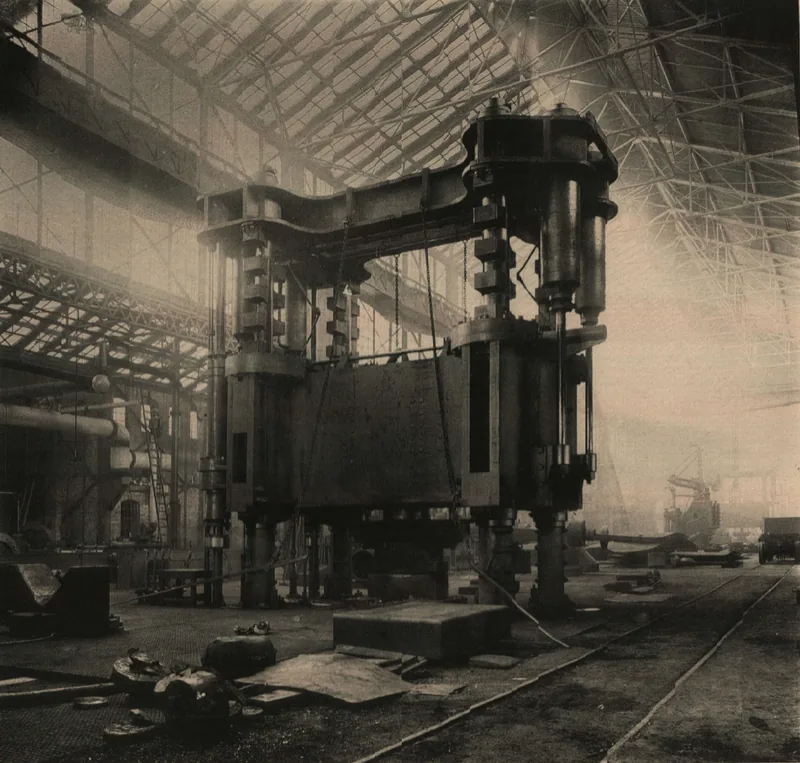
3,000 tons, as the file puts it
The 1892 Krupp photograph is identified on the file as a hydraulic press of 3,000 tons effective power. That wording belongs to the file.
A 1000-ton forging press, recorded by HAER
John Stamets photographed a 1000-ton forging press in Building No. 460 at Puget Sound Naval Shipyard for the Historic American Engineering Record.
A Tangye hide press, circa 1910
A lantern slide of about 1910 is identified as a Tangye 200-ton skin and hide press, rear view.
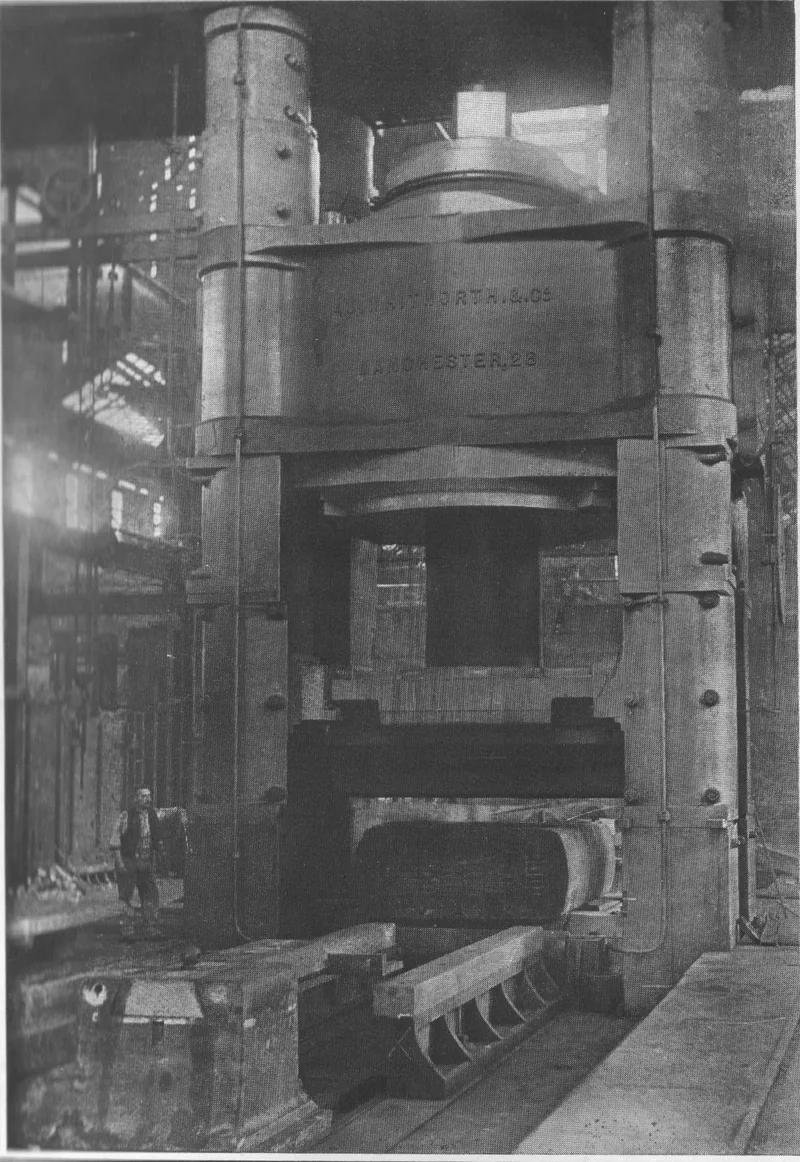
A 1911 book plate of a huge press
A plate in Archibald Williams, The Wonders of Mechanical Ingenuity (1911), is titled on the file as a huge hydraulic press. The plate is the source for what this site says about the picture.
Tower Bridge machinery, as the file identifies it
One photograph is identified on its Commons file as Tower Bridge machinery in London. This site does not add a further official story beyond that identification.
A later portrait print of Pascal
The Pascal image on this site is a later historic portrait print, not a contemporary photograph of him.
A wall of brick by the docks
The Wallasey photograph is identified on its file as the grade II listed, disused pumping station for the East Float and Alfred Docks. The file is used on the website only.
An excavator identified by its name
The yellow machine in one photograph is identified as a Caterpillar 318CL hydraulic excavator. This site is not affiliated with Caterpillar.
The IMechE article is dated 28 December 2017
The Institution of Mechanical Engineers article quoted throughout, by Karyn French, Archivist, is dated 28 December 2017. [source]
The official encyclopaedia is the 1911 edition
The Britannica articles quoted for Bramah, Pascal, Armstrong and Hydraulics are the 1911 Encyclopaedia Britannica, from Wikisource. [source] [source] [source] [source]
The National Trust page is the Cragside visit page
The Cragside wording quoted here is from the National Trust’s visit page for the house, checked for this build. [source]
No Payhip kits on this site
This rebuild has no paid download kits. The shop points to free typographic sheets, printables.im, Amazon searches and the birthdays card.
The desk ratios are not historic ratings
Nothing on this site treats 2×, 5×, 10× or 20× as a recorded rating of Bramah’s press, Armstrong’s crane, or the Krupp, Tangye or Puget Sound machines.
Hydrodynamics is left as the 1911 word
When the 1911 Britannica ranks Pascal among the founders of hydrodynamics, this site does not silently substitute the modern classroom word hydrostatics. [source]
The beer-tap claim is the IMechE’s
That pub customers today can enjoy a fresh drink from the beer tap “thanks to Bramah and his patented beer pump” is the IMechE archivist’s wording. [source]
The New Holland soil is official
The “prohibitive cost of a special reservoir owing to the character of the soil” is the 1911 Britannica’s reason, not a later guess. [source]
Heavy naval guns are a later use of the same system
The 1911 article lists the accumulator’s use “to the manipulation of heavy naval guns and other purposes on warships” among Armstrong’s achievements, after the New Holland story. [source]
Enjoyed this hydraulics desk?
No pop-ups. No intrusive advertising. Just interesting stuff. A little support helps the next mechanics.im site get built.